
The way people search for legal help is evolving. Traditional SEO is still king for now, but people are increasingly turning to platforms like Google’s AI Overviews and ChatGPT for answers and recommendations—even if they weren’t intending to get their answers from artificial intelligence.
Instead of sifting through dozens of links, they’re served with instant, synthesized insights. If your law firm isn’t showing up in these results, you’re invisible to a growing share of your market.
Does that mean you need to throw your SEO playbook in the trash and start over? Not quite. But paying attention now and optimizing for these new search forms alongside traditional SEO will put you ahead of your competitors.

AI Overviews: Google’s Shortcut to Legal Answers
AI Overviews are Google’s new way of delivering quick, AI-generated summaries at the very top of search results. Instead of only listing blue links, Google now compiles information from multiple trusted sources to provide users with a conversational-style answer.
They tend to appear for research-based or informational questions, such as “What happens if you refuse a breathalyzer in Georgia?” or “How is child custody decided in Texas?” These are queries where users want context, explanations, or step-by-step guidance. They usually won’t show up for direct, branded searches for a specific firm, since those are more transactional.
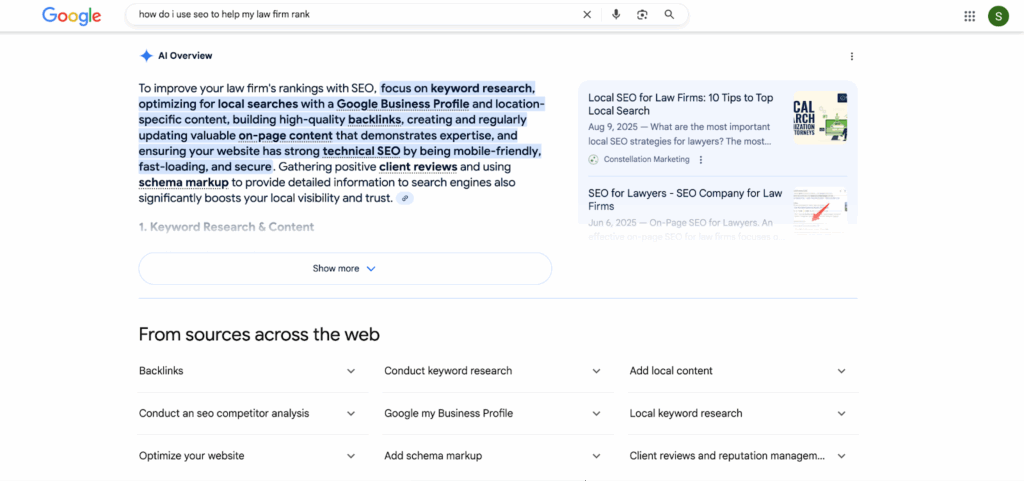
For law firms, this potentially means fewer clicks but increased visibility: your content has a chance to be featured directly in the overview, putting your expertise in front of potential clients.
How to Appear in AI Overviews
If you want your law firm to stand out in Google’s AI Overviews, your content strategy needs to go beyond basic service pages. AI tools look for depth, authority, and breadth of coverage when deciding what to pull into answers. That means creating a library of supplemental content that answers the kinds of legal questions potential clients are already asking.
Here’s how to position your firm’s content for visibility:
- Cover a wide range of legal topics – Publish blog posts, FAQs, and guides that address common questions in your practice areas, from “What is the difference between contested and uncontested divorce?” to “What happens after a DUI arrest?”
- Build topical clusters – Organize content around core themes (e.g., child custody, personal injury claims, estate planning) and link related articles together to show depth of expertise.
- Use schema markup – Add FAQ schema, LegalService schema, and other structured data so Google can easily recognize and surface your content.
- Prioritize authority signals – Include attorney bylines, references to statutes, and citations to reputable sources to reinforce credibility.
- Keep content updated – Laws change frequently; AI tools reward freshness, so review and refresh key content regularly.
This should all sound pretty familiar if you’re already optimizing your content for SEO, because it’s nothing new. Experts have recommended a wide range of topics, clusters, schema, authority signals, and frequent content updates for years to keep your firm visible on Google.
What’s Different About Content That Shows Up in AI Overviews?
Despite a lot of the rules being the same about what to target, there are a few differences between content that’s good for traditional SEO alone, and content that works for both traditional SEO and AI overviews. Here’s how you edge out the competition in the latter:
- Use a question and answer format for headings — Using a Q&A format in your supplemental content lays out clear answers for AI to pull from.
- Ensure each section stands on its own — If you’ve written a blog titled “Can I sue my doctor for malpractice?” and someone is searching for “Can I sue my doctor for malpractice if they didn’t fill a prescription?”, AI overviews should still be able to pull the answer from your blog since it’s a subquery. That means making sure each section is full and complete on its own, and there aren’t callbacks to earlier points in the article (no “as we said earlier…” since this makes it harder for the AI to pull from).
- This also helps from a user experience perspective. Think about opening a page to find an answer you’ve searched for: do you typically read the whole article, or do you scroll to find the information you need and hope it makes sense on its own?
- No negative or disparaging comments — AI overviews don’t want to be negative. They’re programmed to be positive. If your sections constantly mention that insurance companies are the worst and out to get your clients, Google is less likely to cite that.
- Structure the content clearly — Use bullet points, numbered lists, and short paragraphs. AI systems often extract chunks of text, so breaking things up makes it easier for them to pull clean answers.
If you already know how to use keyword research, schema, and other traditional SEO factors to get your content to rank well, those few adjustments will put you competitively in the AI overview space. This is something that a lot of your competitors likely aren’t even thinking about yet.
How to Show Up in ChatGPT Results as a Law Firm
AI Overviews aren’t the only shift—consumers are increasingly using ChatGPT and other AI engines to find legal help online. The good news is that if you’ve already invested in SEO—or you’re working with the right agency—many of the factors ChatGPT looks for in recommending a law firm are probably already in place. These include:
- Strong digital authority – A consistent track record of publishing high-quality, accurate, and useful legal content.
- Client reviews and reputation signals – Positive ratings on platforms like Google and Avvo help reinforce your firm’s trustworthiness. While Google reviews may carry more weight in AI Overviews (since they’re tied directly to local search visibility), Avvo and similar legal-specific platforms can boost credibility in tools like ChatGPT, which often reference industry-specific directories when surfacing firms.
- EEAT signals (Experience, Expertise, Authoritativeness, Trustworthiness) – Clear attorney bios, credentials, case experience, and client trust markers that show real-world expertise.
- Citations across the web – Mentions in reputable directories, bar associations, news outlets, or industry publications that validate your firm’s credibility.
- Comprehensive content coverage – Supplemental blogs, FAQs, and guides that answer a wide range of legal questions, not just service page basics.
- Local relevance – Optimized content tied to your geographic market, since AI tools often prioritize nearby or jurisdiction-specific firms.
- Fresh, updated resources – Regularly revisiting and refreshing content to keep information accurate as laws change.
- Backlinks from trusted sources – Links pointing to your site from high-authority legal, local, or news domains.
This combination makes it far more likely that ChatGPT and other AI engines see your firm as a trusted authority worth mentioning. The firms that start building authority now will be in the best position as AI assistants become a bigger part of how people research legal help. By laying the groundwork early, you make sure your firm is already in the conversation when the shift happens, rather than scrambling to catch up while competitors are already getting mentioned.
Implement the Best Practices for AI Visibility to Get Ahead
Visibility in traditional search results is important, but not the whole picture. AI placements build authority, trust, and direct connection with potential clients. People are increasingly turning to it for help, recommendations, and education.
At EverSpark Interactive, we specialize in helping law firms navigate this new terrain of AI-driven visibility. Since 2009, we’ve delivered real, measurable results for law firms thanks to personalized strategies, executive-level involvement, and a full-funnel approach that blends SEO, content strategy, and technical excellence.
Want to start capturing AI-powered visibility for your firm? Contact us today and let’s talk. We’ll help you craft the content, structure, and outreach strategies that position your firm as the answer AI tools turn to before your competitors even surface.